Neuroscience Behind Zombies
Neuroscience Behind Zombies
Zombie origins
The folkloric zombie is traditionally associated with the French colonies of the Caribbean, particularly Saint-Domingue (which became Haiti in 1804) and the French Antilles. In the 18th century, the slave sugar plantations there produced staggering wealth for the French bourgeoisie, but at appalling death rates in the slaves carried over from West Africa.
There is some speculation that the word zombi, as it first appeared in French and English sources in the 19th century, derives from West African languages – ndzumbi means corpse in Mitsogo, zumbi a fetish or spirit in Kikongo (see Ackermann & Gauthier, 1991). The brutal Code Noir, the legal document issued by the French state, demanded that all slaves be forcibly converted to Catholicism. This only resulted in syncretic forms of religion and a thriving world of underground ritual practice. In Jamaica, under the English, this was called Obeah. In Saint-Domingue it was called Vaudoux or Voodoo.
The first version of the zombi was said to be a person whose spirit had been captured by a Voodoo priest. The victim was struck down with a paralysis so profound it was mistaken for death. The body was then retrieved soon after burial and revived in a kind of cataleptic state and put to work for his new master.
This was an overt echo of the master–slave dynamic. What is called the ‘social death’ of slavery by Orlando Patterson (1982) – where one is stripped of name, kinships and autonomy, and forced to labour beyond endurance – is here rendered as a literal ‘undead’ state.
In the paranoid world of the French colonial planters, Voodoo priests were thought to work with poisons, or induce these trance states through mesmerism. While Franz Mesmer claimed to cure his patients by placing them ‘en rapport’ and manipulating flows of ‘animal magnetism’ in the 1780s, the French colonies feared any such influences and banned the practice at once. It was too late: the suggestible slaves were ‘mesmerised’ into rebellion in 1791 by these dark arts, and had overthrown the French by 1804, when Haiti became the first independent black republic. For much of the 19th century, Haiti was demonised as a Gothic nightmare of cannibalism, savagery and the undead, all to make the white European empires feel better about their ‘civilising’ mission.
Post-colonial zombies
This became the standard mode of post-war psychiatry in the service of enlightened, progressive nationalism and decolonisation – local superstitions needed to be overcome to bring new nations forward in development. The leading psychiatrist in this arena was Franz Fanon, who came from the French island of Martinique – still technically a colony of the French state. Fanon trained in Paris and developed an influential political theory of the colonised self in the existential psychology of The Wretched of the Earth. Fanon treated traumatised victims of the war for Algerian independence in the late 1950s and early 1960s.
For Fanon, black consciousness needed to free itself from debilitating superstitions – ‘leopard-men, serpent-men, [and] zombies’ – with liberating reason. These beliefs only reinforced subjection under a ‘death reflex’. Yet Fanon was also treating ‘conversion’ symptoms of war trauma, states of paralysis and catatonia that sound like shell-shock cases, but also rather like the classic zombie of the French Caribbean: ‘It is an extended rigidity and walking is performed in small steps… The face is rigid but expresses a marked degree of bewilderment… He is constantly tense, waiting between life and death’ (Fanon, 1985).
As if to draw out this implication, Jean-Paul Sartre’s introduction proclaimed Fanon’s work a dialectical and revolutionary reversal of white and black power. ‘Turn and turn about,’ Sartre proclaimed to his (presumed white) readers, ‘in these shadows… it is you who are the zombies’ (in Fanon, 1985).
After the end
The shift from the zombified individual to the indifferent mass might appear to suggest that psychology has been evacuated from the trope. The focus of the Romero paradigm, up to and including The Walking Dead, is on the survivor and models of post-traumatic ’emergency’ states of consciousness. Right at the beginning of the trauma paradigm, Robert Jay Lifton suggested that in the post-1945 era humanity had become saturated in ‘death imagery’ and had to live with the permanent threat of global extinction (Lifton, 1968). Survivorhood has become a privileged locus of identity since the diagnostic manuals identified post-traumatic stress disorder in 1980.
However, there are recent signs that zombies are re-acquiring consciousness in popular culture – a shift back to an interest in what it might mean to exist in a state where the self has been fractured and lost but might yet find a kind of fragile recovery. The TV series In the Flesh and iZombie still find interest in the zombie and keep it as currently the most evocative Gothic form for investigating the limits of life and death and how personhood can be defined.
What does a zombie think about?
Ever since 1968’s Night of the Living Dead, Hollywood has offered up a near-continuous slew of zombie films; judging from their take, zombies are not great thinkers.
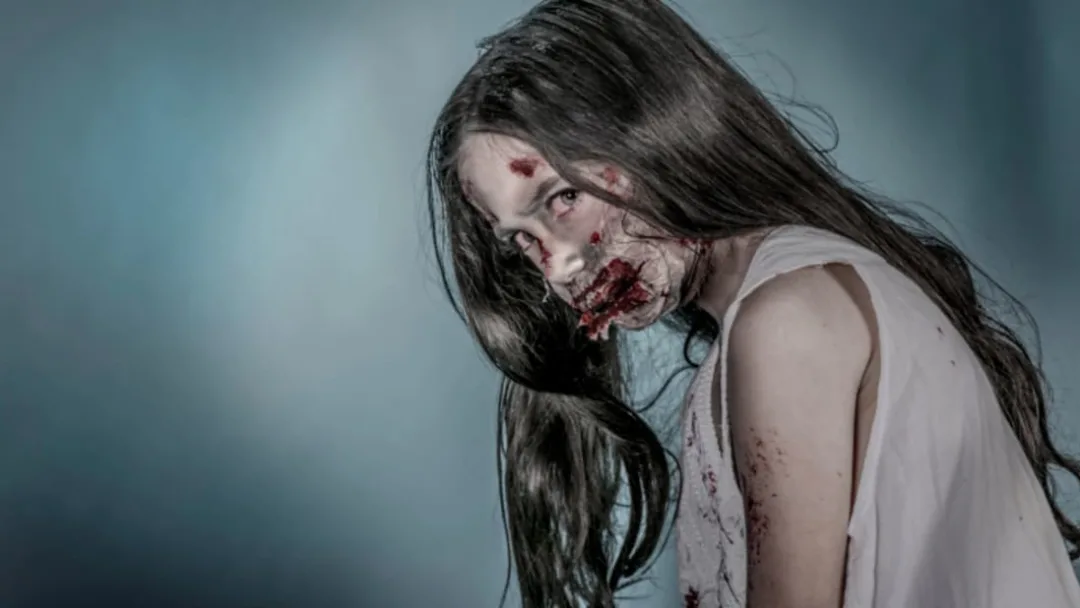
Your standard zombie is a pretty simple creature. It is dead but mobile. It lumbers around, mouth agape, seeking humans to prey upon. It often operates in shuffling groups. Many zombies are completely silent (the ones in Night of the Living Dead and The Walking Dead, for instance, don’t talk). Though some may grunt and moan.
In some movies, such as The Return of the Living Dead (1985), zombies maintain simple vocabularies. Such utterances reflect the basic desire of your typical zombie—a hunger for flesh, human brains being the ultimate zombie delicacy.
Most zombie movies and books don’t go beyond these parameters in terms of zombie thought. Zombies are simple creatures, driven by a basic appetite, and that’s all they “think” about. I put this in quotes because the very definition of zombie seems to involve an utter lack of human cognition and thoughtfulness.
This zombie blueprint lets horror creators build worlds that audiences can quickly wrap their own brains around. Zombie rules are straightforward, and let us quickly see who’s good, who’s bad, and what needs to be done (this typically consists of attacking the zombie’s brain).
But there is an interesting line of thought about what is going on in the zombie’s head. What if there is something human left? What if they still have thoughts, somewhere deep down inside? These questions take us to interesting places. If we consider what makes a zombie a zombie, then we might think anew about what makes a human a human.
The young adult genre offers a few tantalizing proposals. In Isaac Marion’s Warm Bodies, for example, we get the story of a zombie who emerges from the zombie fog and yearns to return to humanity. He wants to fall in love.
Marion’s book is told in the first-person from the perspective of a zombie named “R.” He’s called “R” because, like all zombies, he’s forgotten his name (“We lose them like car keys, forget them like anniversaries”). Milling about a decrepit airport by day, R occasionally joins zombie packs in search of human brains. On one trip, his band encounters and devours a group of young zombie hunters. But this time is different. One hunter, a girl named Julie, is special to R. He decides to rescue her and bring her back to the airport.
In the tale to come, R finds a connection with Julie because he’s absorbed the memories of her boyfriend by eating his brains. Through this connection, R gradually begins to gain language, emotions, and feelings. He begins to reconnect with his lost humanity.
Not to give away too much, R rehumanizes and then leads a zombie movement back to “life.” He can do this because zombies, in this book, are not entirely dead. They are, cribbing from the classic film The Princess Bride, just “mostly dead.”
Being mostly dead is of course very destructive. Warm Bodies has lots of flesh-hungry zombies creeping around and makes it clear that the zombie plague has thoroughly destroyed civilization. Yet the zombies here also remind us of what makes us human in the first place.
R at one point ponders what the zombie apocalypse did. “It didn’t take much,” he ruminates, “to bring down the card house of civilization. Just a few gusts and it was done, the balance tipped, the spell broken. Good citizens realized the lines that had shaped their lives were imaginary and easily crossed. They had wants and needs and the power to satisfy them, so they did. The moment the lights went out, everyone stopped pretending.”
Through R’s thoughts, Marion delivers us a warning. Lest we forget empathy, kindness, and, yes, love, we risk the destruction of everything that we hold dear. Zombies have a message to impart to the living, contends this book. That is, a message beyond Run for Your Lives!
In their insatiable hunger, Marion’s zombies reflect darkly the inhumanity that lies in us all. In his slow return to the world of the living, R communicates a means of getting back to what is best in us. He offers a strange voyage of recovery, a sojourn to a better, more humane, world.
What do zombies think about? Eating brains, obviously. But somewhere, deep down inside of some zombies, there exists a dim spark of love and humanity. Finding this spark is not just the prerogative of the zombie. It is the hope for us all.
Zombies are very impulsive
Another notable zombie trait is the inability to recognize anyone from its former life. That’s because zombies suffer from prosopagnosia, otherwise known as face blindness. And damage to the hippocampus causes retrograde amnesia, making every day seem the same. Zombies possess no long-term memories.
“Zombies are very impulsive and have emotional disruption,” Vestrymen says. But this differs from their inability to remember. The duo suspects that if they existed, zombies would have injured Papez’s circuits, a neural highway that connects the amygdala, hippocampus, and limbic system in the brain, and helps with the creation of emotional memories. This damage also means it’s harder for zombies to control their angry impulses.
On top of this rage, zombies can’t verbally express their angst because of a flawed arcuate fasciculus, which connects two regions of the brain responsible for language. Because Broca’s area fails, zombies can only groan and grunt (and possibly mumble “brains”) while damage in Wernicke’s area makes it impossible for them to understand pleas of mercy from their victims.
While the zombie brain has a lot of problems, Vestrymen notes their senses and motor control remain intact. “We wanted the science to be 100 percent real,” Vestrymen says. He and Voytek, an assistant professor at the University of California, San Diego, have been working on a book on the history of neuroscience and the neuroscience of zombies, which Princeton University Press will publish next year.
The shift to America
The zombi of folklore became the zombie of popular American culture only in the 1920s. The extraordinary travel writer and adventurer William Seabrook visited Haiti during the colonial occupation by American forces, between 1915 and 1934. In his sensational travelogue Magic Island, first published in 1929, Seabrook not only reported joining a Voodoo cult, attending rituals, and feeling the power of the gods coursing through his veins after drinking sacrificial blood, but also claimed to have been introduced to a group of ‘dead men working in cane fields’: zombies. ‘The zombie, they say, is a soulless human corpse, still dead, but taken from the grave and endowed by sorcery with a mechanical semblance of life’ (Seabrook, 1966).
Seabrook was fascinated by the occult but usually offered his accounts of witchcraft and the supernatural as a sceptical ‘psychical researcher’ (the term favoured in the 1920s, just before ‘parapsychology’ was coined). The encounter in the cane fields produced a ‘mental panic’ in him, however:
The eyes were the worst. It was not my imagination. They were in truth like the eyes of a dead man, not blind, but staring, unfocused, unseeing. The whole face, for that matter, was bad enough. It was vacant, as if there was nothing behind it. (Seabrook, 1929/1966)
Soon enough in his account, Seabrook decided that these creatures were ‘nothing but poor ordinary demented human beings, idiots, forced to toil in the fields’, A rational explanation presented itself. He did not have the insight to reflect that it was the American occupiers who had re-introduced forced labour back into plantations after over a hundred years of Haitian freedom. No wonder the local population felt that conditions for the ‘zombie’ had returned.
Too late! Seabrook’s book became the primary source material for the first American zombie film, White Zombie, which appeared in 1932. In it, Bela Lugosi, fresh from his role as Count Dracula, plays another evil foreign mesmerist able to control his enemies, enslave workers, and pursue pure white American beauties with his dastardly hypnotic powers (see Rhodes, 2001). Tropes from American and European Gothic literature fused with colonial superstition to create a new heady brew.
Actually, the zombie was secured in the American imagination by literally becoming a heady brew: the potent Zombie Cocktail was a sensation in the tiki bar craze of the 1930s. Customers were limited to two; more, everyone was warned, would induce brain death.
Zora Neale Hurston’s ‘real’ zombie
Another important visitor to Haiti in the 1930s was the writer Zora Neale Hurston. Best known as a novelist associated with the Harlem Renaissance, Hurston also trained as an anthropologist at Columbia University under Franz Boas, and as a black woman was considered to have great potential as a fieldworker. She wrote up her findings on ‘Hoodoo’ folk medicine practised amongst the black folk of New Orleans for the Journal of American Folklore in 1931. She started training as a healer, but apparently broke off after some confounding incidents that she hinted at but which wouldn’t quite fit into academic discourse. This was nothing compared to what she found in Haiti.
Hurston wrote the fractured and strange book Tell My Horse about Haiti, which included her outline of Voodoo rituals and beliefs. In her unlucky chapter 13, she not only discusses zombies, but visits one and photographs her terrible, traumatised face. This ‘remnant’ or ‘wreckage’ of a former person was Felicia Felix-Mentor, a woman who had died in 1907, but allegedly in 1936 had been found naked and stumbling along the road towards a farm where her family had once lived. The family and surrounding village assumed that Felicia had been in bondage to a zombie master who had eventually died, freeing her corpse to its last compulsion: to return home (Hurston, 1938).
Felicia is a monstrous creature, outcast and rejected by a social organisation that refuses her personhood. Hurston finds her in a mental hospital, understandably, yet is fully prepared to accept the zombie thesis. Shortly afterwards, Hurston became convinced that she was being slowly poisoned by secret societies that objected to her anthropological investigations and she left the island in fear of her life.
In 1945 Louis Mars, a professor of psychiatry in Haiti (and eventually a Haitian government minister) directly addressed Hurston’s findings in Man, America’s leading anthropological journal. The case of Felicia, he said, was ‘evidently a case of schizophrenia’ and expressed anger that through credulous accounts like Tell My Horse ‘tourists believe that they will be able to see zombies roaming through villages’ (Mars, 1945).
Box – All together now
How did the zombie move from the unlucky lone individual ‘Mesmerised’ by a voodoo priest to become the vast anonymous horde familiar today? The answer lies in the traumatic wake of the Second World War. The atomic bomb put the entire globe at risk and imposed on everyone what Robert Jay Lifton called a saturation in death. This mass ‘death image’ might be one source for our wholesale zombification, as might the accounts that soon emerged after the war of the masses of ‘living dead’ in the German concentration camp system.
But it was the early years of the Cold War that really produced an important representation of ‘zombie’ masses. When American troops were sent into Korea in 1950 to prevent the advance of Chinese Communist forces, they were confronted by a horrifying new battlefield tactic: the ‘human wave’. Mao Zedong ordered hundreds of thousands of peasant soldiers forward with the aim of overrunning well-armed positions simply through force of numbers. Its initial success was ascribed to the horror American soldiers felt at being forced to mow down thousands of peasants. Since Romero’s 1968 classic, Night of the Living Dead, the zombie genre always features these undead masses pressing at the windows and doors of the last human redoubt.
There was a political tinge to this image, of course. One of the early zombie films, Revolt of the Zombies (1936) ended with images of a long-dead Asian army re-awoken from sleep and inexorably advancing. In this case, it fed into American xenophobia about Chinese immigration.
After the end of the war, the threat of Chinese Communism in particular was understood as a risk of brainwashing. The Chinese Communist Party was known to use techniques of ‘thought reform’ or political re-education. The Chinese term Hsi nao was evocatively translated as ‘brainwashing’ in 1950. This stuck rather better than the term suggested in the American Journal of Psychology in 1951: ‘menticide’. American psychologists, politicians, and popular culture united in a panic narrative that fiendish foreigners might infiltrate the country and turn American citizens into ‘zombies’, potential traitors or assassins without a will of their own. The most overtly psychological rendition of this fear was The Manchurian Candidate, a novel in 1959 about a soldier returning from Korea, zombified into an assassin by his Communist handler. It was released as a film in November 1962, just as Kennedy was assassinated, and the film was rapidly withdrawn. Here is another psychological root of the modern zombie.
The Real-Life Neuroscience Behind Zombies
Most of the zombies you see on television and in movies moan and groan, and pull and tear, and lumber and shuffle, and remain highly focused on finding brains to eat. But why do zombies act the way they do? They suffer from Consciousness Deficit Hypoactivity Disorder, an ailment coined by Timothy Verstynen and Brad Voytek.
“We are tricking people into learning neuroscience and history of neuroscience by talking about zombies,” says Verstynen, an assistant professor in the psychology department at Carnegie Mellon University in Pittsburgh (knowing that Pittsburgh-native George Romero filmed Night of the Living Dead in the area had just a little to do with him moving there). The two presented the neuroscience of zombies at Zombie on in 2010 and produced a presentation for Tended about it.
As any consumer of pop culture knows, a zombie’s main characteristic is its drive to eat human flesh. Vestrymen and Voytek say that if they really existed, zombies would be hungry because they have lost some hypothalamic functioning, which controls satiety. People with this kind of damage eat and drink nonstop. “Zombies are constantly trying to eat people because they are never full,” Vestrymen says. And they can only focus on the immediate problem—and if that means the food is moving, then zombies are hungry.
These shuffling undead have terrible attention spans and can only focus on what’s right in front of their faces, likely due to damage in their parietal lobe. They experience something like the real-life Bálint’s syndrome, which renders sufferers only able to see the thing that requires the most attention. They observe the person running across the room, not the group of zombie hunters standing in the corner. In case you ever find yourself facing a zombie, keep this in mind: It’s actually better to stop and hide than try to run, Vestrymen says.
When the zombies ruthlessly hunt people, they walk with a specific gait, wide-legged and lumbering, thanks to spinocerebellar ataxia. This movement disorder, caused by damage and atrophy in the cerebellum, contributes to an awkward, halting walk with slurred speech and balance problems. When the duo met Romero at Zombie on, they asked him why the zombies moved so slowly, assuming he had an elaborate theory. He simply said that zombies were dead, so he thought they’d walk stiffly.
Fast zombies, as seen in 28 Days Later or World War Z, move with such speed because they took less time to resurrect, what Vestrymen and Voytek call the resurrection hypothesis. “Fast zombies themselves have less brain damage than the slow ones,” says Verstynen. It’s like hypoxia, when the brain is deprived of oxygen. The longer one goes without oxygen, the more damage she will have.